Mechanical Engineering -  Engineering Mechanics at Michigan Technological University Go to Michigan Tech home page Takes you to University Web page for Prospective Students Takes you to University Web page for Current Students Complete List of Majors and Minors for all Colleges and Schools Go to Michigan Tech Athletics Website Visit the University Alumni Page Information for Parents Web Page for Faculty and Staff Search Michigan Tech Campus The Whole University Directory from A to Z Go to Michigan Tech Mechanical Engineering Department home page

Research

Research Features

q

q

NVH Testing with Innovative Boundary Conditions
Students in Chuck Van Karsen’s Experimental Vibro- Acoustics graduate class were given an opportunity to study a small fiberglass boat equipped with a 90 hp outboard motor that exhibited excessive levels of vibration at operator interface locations. They conducted operational testing, modal analysis, and a path characterization study of the interface between the hull , motor, and operator. Due to the timing of the project, the test track at Michigan Tech was frozen for most of the project. An innovative boundary condition that simulated the eff ects of having the boat in water was utilized to complete the project.
q
q Nonlinear Crane Controls Reduce Hazardous Payload Motion
US Navy ship cranes are used for at-sea cargo transfer between ships for both military and humanitarian needs. Operation in rough seas can cause large payload motion (+/- 5m) in a short amount of time (30 seconds). Dr. Gordon Parker and his students are developing nonlinear control strategies for cranes that reduce these hazardous payload motions through ship motion compensation and active swing damping. Eventually, this will facilitate cargo transfer between ships while underway in extreme weather conditions.

Orientation of Carbon Nanotubes

Orientation of Carbon Nanotubes

Find out more Multi-Scale Technologies Institute

Orientation of CNTs Creates Electrical Nanoconnections

Dr. Craig Friedrich and his team are exploring ways in which, using a high frequency electric field, carbon nanotubes(CNTs) can be oriented and deposited to make electrical nanoconnections. Here, two CNTs each 50nm in diameter and shown magnified 60,000 times, bridge a gap of 2 microns connecting gold electrodes. Traditionally, the presence of the CNTs had to be verified by inspection using a scanning electron microscope, as shown here. However, Friedrich’s research has demonstrated that the changing electrical properties of the electrode gap in real time during deposition can be measured verifying the presence or absence of the CNTs without further inspection.


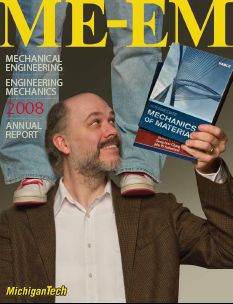
MEEM Annual Report

Download 2006 Annual Report PDF file 2 Mb

Download Adobe Acrobat PDF file 3.9 Mb

q

Faculty Research Brochure

Faculty Research Brochure
(1 Mb PDF File)

q

Michigan Tech Research

University Research Magazine 2008

University Research Magazine 2007

University Research Magazine 2006

University Research Magazine 2005

University Research Magazine 2004

Brochures for Teaching Focus Areas